
Freedom
Freedom does not come with money
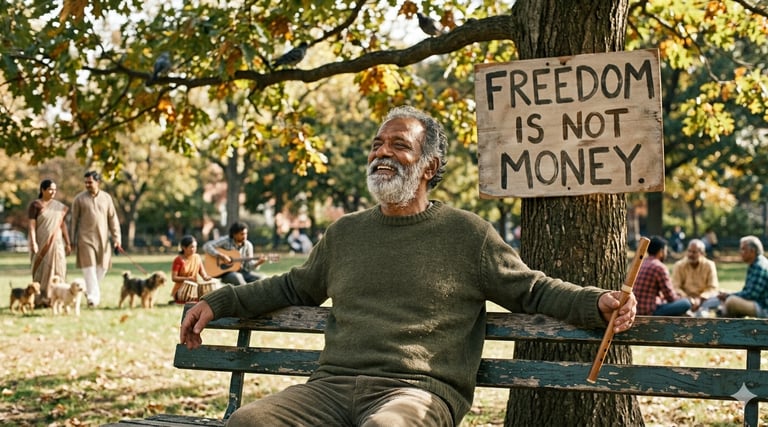
Sometimes space is necessary — a space that feels empty, peaceful, and free.
Throughout my life, I have always tried to earn and achieve things. In my job, I have worked very hard. In my family, I have tried to settle situations and keep relationships together. At home, I have learned to compromise. Even in material things, I adjusted myself with a small car instead of immediately chasing something expensive.
But despite having many things, I still carried the urge to have more — a bigger house, a better car, more investments, a better body, a better lifestyle, and more financial security.
And honestly, this is how most people live. We think:
“Once I get that promotion, life will feel better.”
“Once I buy that dream house, I will finally relax.”
“Once my investments grow enough, I will stop worrying.”
“Once I achieve this one goal, I will feel free.”
But the strange thing about life is that the moment we achieve one thing, the mind quietly creates another target.
A person earning ₹30,000 thinks peace will come at ₹1 lakh.
A person earning ₹1 lakh thinks peace will come at ₹5 lakhs.
A person with one house wants another.
A person with one successful business wants a second.
And sometimes, even after achieving everything they once dreamed of, they still cannot sleep peacefully. That made me question something deeply:
Do achievements actually give freedom, or do they slowly increase responsibility, fear, and pressure?
The more I started gaining things — a better designation, growth in investments, goals for a better body, a better family life — the more I realized that I was constantly investing my energy into maintaining everything.
And maintaining things is harder than achieving them.
When you have no investments, there is no stress about market crashes.
When you have no status, there is no fear of losing reputation.
When you own little, there is little to protect.
But once you build things, your mind also starts carrying the weight of protecting them.
A small fall in investments affects your mood.
A problem at work disturbs your sleep.
One unexpected life event suddenly shakes the emotional foundation you spent years building.
And then you realize something important:
Sometimes we are not enjoying the things we own anymore.
We are only worrying about losing them.
One day, while I was out for a walk, I saw a man sleeping on the street. He had no proper clothes, no house, and probably no certainty about his next meal. Yet he was sleeping peacefully at 8 AM.
And then I looked at myself.
I have a house, a comfortable bed, food before sleeping, food after waking up — yet there are days when my mind wakes me up at 5 AM automatically because it is already running behind responsibilities, work pressure, investments, future planning, and problems that may not even happen.
Doesn’t that sound strange?
The person with nothing was sleeping peacefully.
The person with comfort was mentally restless.
And this is where life becomes confusing.
Because I also know that living on the streets without stability is not a good life either. Poverty brings pain, helplessness, insecurity, and suffering. A person struggling for food and survival also carries heavy pain inside.
So then what is the right way to live?
Should we chase everything?
Or should we give up everything?
Maybe both extremes create suffering in different ways.
A life of endless chasing can slowly drain your peace.
But completely disconnecting from ambition and responsibility is also not practical for most people.
And this is where I realized that even Gautama Buddha faced a similar struggle.
Before finding enlightenment, he tried extreme practices because people believed suffering and severe discipline would lead to spiritual awakening. He fasted to dangerous levels, pushed his body to pain, and lived with almost nothing. But even after all that suffering, he still did not find the peace he was searching for.
Eventually, he understood something powerful:
Neither extreme attachment nor extreme suffering brings balance. That is why he chose the Middle Way. A path where you do not become obsessed with collecting more and more, but you also do not abandon life completely.
And maybe that lesson still applies today because modern life has created a different kind of suffering. Today people are not starving in forests to find peace. Instead, they are mentally exhausting themselves trying to maintain lifestyles, social status, financial goals, and comparisons.
People buy bigger homes but lose peaceful sleep.
People earn more money but lose time with family.
People achieve fitness goals but become mentally harsh on themselves.
People collect followers online but feel lonely inside.
The problem is not success itself. The problem begins when success takes away inner peace instead of improving life.
Maybe true freedom is not about having everything.
And maybe true freedom is also not about giving up everything.
Maybe true freedom is being able to enjoy what you already have without constantly feeling incomplete.
To grow without becoming mentally trapped.
To earn without losing health.
To dream without destroying peace of mind.
To improve life gradually without turning life into a constant race.
We do not always need to take extreme risks just to become millionaires overnight. Because sometimes, in trying to gain everything, people lose even the little peace they already had.
And maybe that is the balance life quietly tries to teach us:
Progress is important.
Ambition is important.
Growth is important.
But peace of mind is important too.
Because at the end of the day, a person who has less but sleeps peacefully may already possess something that many successful people are still searching for.