
Karma
The Accountability You Can Never Escape
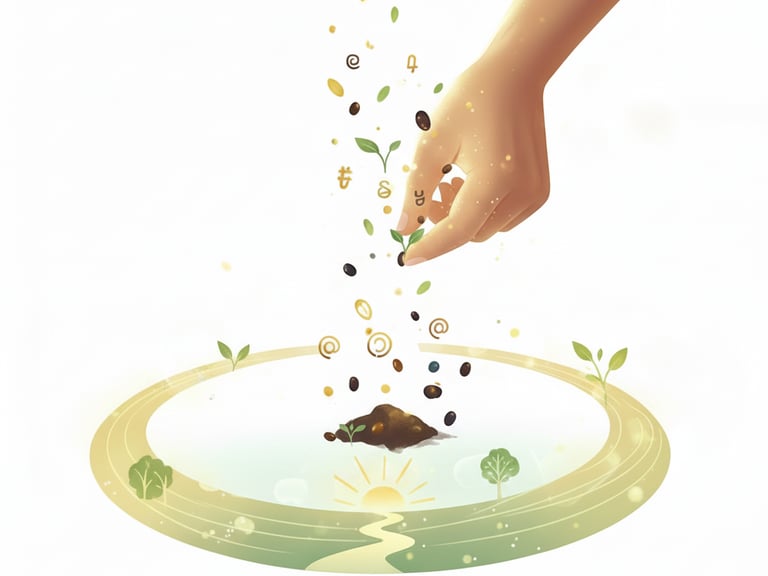
The word “Karma” is something every Indian grows up hearing. I’ve heard it since childhood too, but I never truly understood it… not until my own mind got trapped in the endless maze of right and wrong in this world. What most of us understand is simple: do good and God will favour you; do bad and God will punish you. And because of this, people carry a silent fear inside them — a fear of every action.
This word is so powerful that even if someone is just passing by a temple, they will immediately bow their head — either to greet, to show respect, or quietly ask for forgiveness. It’s like a silent fear living inside people… a fear of doing something wrong.
But is karma really that strong?
The surprising thing is — yes, it is. It shapes our future. Not just the next 20–30 years… but the future of many births ahead.
Yet, even though we’re so scared of it, do we actually care? Honestly — no. Whenever we’re about to do something wrong, we rarely pause to think about the consequences. We just go ahead. It’s exactly like the warning on a cigarette packet — it clearly says smoking is harmful, but people still smoke. Deep down, everyone knows when they’re doing something wrong, but they still choose to do it, even after knowing it can cause pain later.
People say the concept of karma is just a belief, not a science. But is that really true? Hindu scriptures talk about karma endlessly, but for many, it still feels like a myth. To me, karma is not a concept — it’s a fundamental rule of Nature.
Just look around the next time you’re in a crowded place. You’ll see people of every kind — some rushing, some lost, some smiling, some broken. Now imagine if you had to make every single one of them think the same thought at the same time — just think the same thought for one second.
Impossible, right?
Or if tomorrow morning the law and money disappeared — the law which binds us from doing wrong things — no law — would people still behave? Would anyone still work, help others, or choose honesty?
We know the answer is chaos.
Now zoom out even more.
Think about the universe — not just Earth, not just our solar system — but billions of galaxies, each galaxy holding billions of stars, and many of those stars holding planets like ours.
We don’t know how many Earths exist.
We don’t know how many beings exist.
We don’t even know how vast our universe is.
When you stand under the night sky, those tiny dots of light you see are “stars.” And if you use a telescope, you see beyond and find that many of them are entire galaxies.
Entire worlds. Entire histories. Entire lives.
If our world looks complicated with just 8 billion people… imagine managing the karma of trillions of lives across endless space.
Can such a vast, layered, interconnected existence run without some common rule?
Without accountability?
Without a system that balances actions and outcomes?
That rule is Karma.
We see its effects every day. Some people are born with abundance, some with struggle. Some inherit sharp minds, some inherit limitations. Some begin life with love and support, while others begin with loss and trauma.
It’s not just material differences. It’s emotional strength, physical health, mental clarity, opportunities, instincts — all different. All shaped by something deeper than luck.
Karma does not shout. It quietly designs the starting point of each life.
And the more you observe the world, the more you realise:
Every life begins exactly where its karma places it.
Life is not random.
Something shapes it.
Something decides.
And that “something” is what we often call karma.