
Society of High Rise and Selfishness
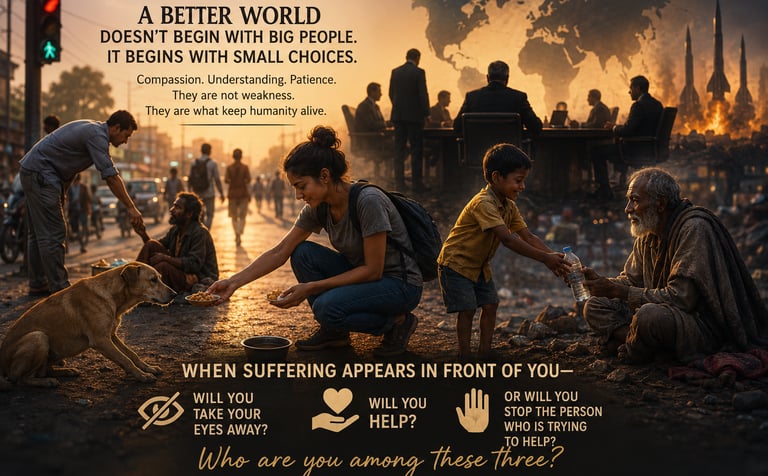
Who are you among the three?
When you step outside today, try observing something for a moment.
Not the roads. Not the buildings. Not the advertisements. Not the people rushing to reach somewhere.
Instead, observe what quietly exists around all of it.
Notice the dog lying near the gate of your society, waiting for someone to leave food behind. Notice the monkeys near the temple who have somehow learned that humans may leave something for them to survive. Notice the elderly person sitting silently on the roadside, the worker carrying bricks under the afternoon sun, the child selling small items instead of going to school, or the person standing at the traffic signal asking for help.
Now ask yourself something.
How many people actually noticed them?
And among those who noticed, how many stopped?
You may remember seeing some people helping—someone placing water outside for birds during summer, someone feeding animals regularly, someone helping an elderly stranger cross the road, or someone quietly offering food without expecting appreciation. Those people exist.
But if you compare that number to the total number of people who pass by every day, it often feels surprisingly small.
And perhaps that is the uncomfortable question.
Not because people are bad.
But because somewhere in our race to become successful, efficient, secure, and comfortable, we have slowly become disconnected from things that do not directly belong to us.
Today, we live in one of the most advanced periods in human history. We build taller buildings than ever before, food reaches us within minutes, knowledge is available instantly, and technology solves problems our ancestors could never imagine. Human capability has reached extraordinary heights.
Yet somewhere alongside this progress, another thing seems to have quietly grown.
Not ambition.
Not achievement.
But sometimes… selfishness.
The problem is not that people want better homes or better lives. The problem is not that people want careers, wealth, comfort, or dreams. Progress itself is not wrong.
The problem begins when our world becomes so centered around ourselves that there is no space left for anyone else.
And sometimes it goes even further.
Not only do we choose not to help—but we begin questioning those who do.
You may have heard things like:
“Why are you feeding these dogs?”
“Why are you helping them? They will keep asking.”
“This is not your responsibility.”
“The government should take care of this.”
Maybe.
But if everyone keeps waiting for someone else—
who acts?
If we look at how societies have changed over time, something interesting appears.
Years ago, many people lived in larger spaces. There were open grounds, trees, neighbours who knew each other, and evenings spent outside homes. Children played together, people visited one another without planning weeks in advance, and relationships occupied more space in daily life.
Life was not easier financially.
But people often felt less alone.
Then cities expanded.
Buildings became taller.
Homes became smaller.
Societies became denser.
Thousands of people started living close to one another.
And strangely, even though physical distance reduced, emotional distance increased.
Today we know passwords better than neighbours.
We know delivery timings better than someone’s struggles.
We have become experts at convenience but forgotten connection.
Progress gave us comfort.
But comfort alone does not create humanity.
And then there are those who remain at the edge of all this progress—the child born into poverty, the elderly person abandoned, the worker earning just enough to survive, the person sleeping on a footpath, the stray dog surviving on leftovers, the injured animal nobody notices.
Was it their choice?
People often say, “They should work harder.”
But life is rarely that simple.
Research across economics, psychology, and sociology repeatedly shows that where someone is born, access to education, family stability, health, opportunities, and unexpected life events shape outcomes more than we realize.
This does not mean effort does not matter.
It means compassion should exist alongside judgment.
And yes, governments have responsibilities. Systems matter. Policies matter.
But what if the problem still exists in front of us?
What if there are still hungry animals in your neighbourhood?
What if people still sleep outside?
What if someone still needs help today?
Can responsibility only move upward?
Or does some of it come back to us?
No one person can solve everything.
But everyone can reduce something.
One meal.
One bottle of water.
One blanket.
One conversation.
One moment of patience.
Or simply one decision not to stop someone else from helping.
And if we zoom out even further, we sometimes see the same pattern at the level of entire nations.
There are moments in history when leaders—people trusted with guiding millions—allow fear, power, ego, competition, or ambition to become stronger than compassion.
They explain why destruction is necessary.
Why conflict is justified.
Why suffering is unavoidable.
Why another nation must be pressured or attacked.
These are people who already lead entire nations.
They already have influence.
They already have resources.
Yet history repeatedly reminds us that having more does not always remove the desire to acquire more.
And when dialogue fails, ordinary people carry the cost.
Families.
Children.
Workers.
Animals.
Entire generations.
The difficult part is that these problems feel too large.
So we tell ourselves:
“What difference can I make?”
But every large act of destruction and every large act of healing begins with smaller human choices.
The choice to understand instead of assume.
The choice to communicate instead of hate.
The choice to support instead of divide.
The choice to help instead of ignore.
Compassion is not weakness.
Helping is not losing.
Nature has always shown us this.
Nothing survives completely alone.
And perhaps what worries me even more than the absence of help is how normal indifference has become.
We walk past.
We scroll.
We move on.
And slowly, suffering becomes background noise.
But maybe society does not become better through one big action.
Maybe it changes through millions of small ones.
Someone feeds one animal.
Someone teaches one child.
Someone listens.
Someone gives dignity.
Someone simply chooses not to interfere with goodness.
So next time you see someone helping—pause before judging.
Maybe that small act is holding together more humanity than we realize.
And then ask yourself—
When suffering appears in front of you—
Will you take your eyes away?
Will you help?
Or will you stop the person who is trying to help?
Who are you among these three?