
We Are Given
Why Hard Work Matters — But Grace Comes First
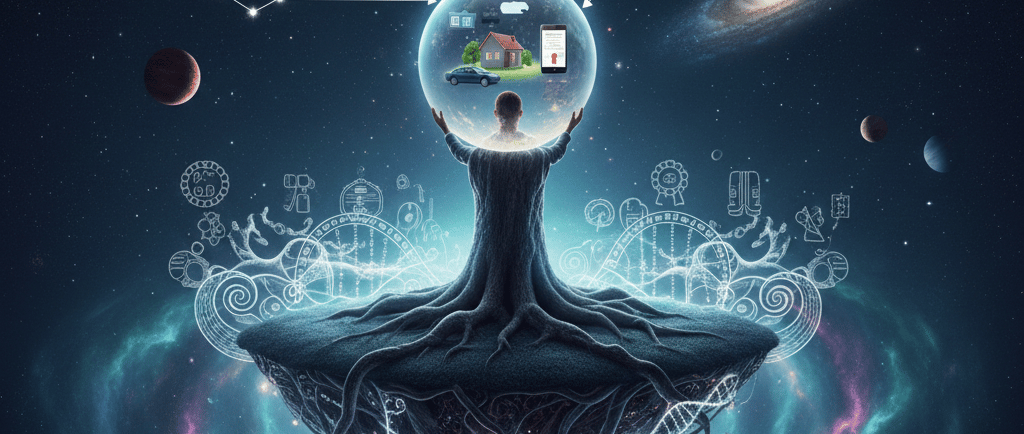
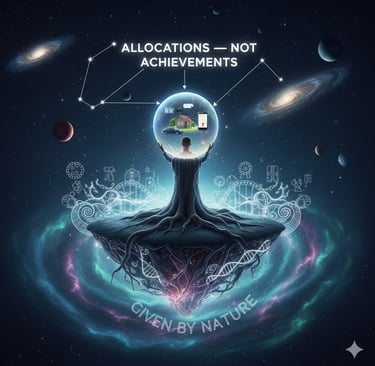
Whenever I look around myself, I see an incredibly diverse world — different people, different plants, trees, animals. Beyond living beings, I also see the vast resources Nature has given us. Without these resources, the luxury and comfort that money provides today would not even exist. Money itself has no value unless something real exists behind it — land, energy, minerals, food, technology, and human effort.
I often wonder how all these things came into existence.
And more importantly, what if they didn’t?
Imagine our lives without basic resources like water, electricity, or fuel. Even the richest person would be powerless. Now imagine the 21st century without mobile phones. Life might have been simpler — fewer distractions, more human connection — but at the same time, global growth, businesses, and opportunities would have been severely limited. Technology did not just change convenience; it changed the scale of human potential.
Then I think about inventions themselves.
Take the phone, air conditioners, television, Coca-Cola, stock markets, or the internet. Were these discoveries random? Or were they purely the result of hard work? Millions of people work hard every day, yet only a few create something that changes the world. Clearly, hard work alone cannot explain it.
Consider electricity. The same lightning existed for thousands of years, but only a few minds were able to understand it, capture it, and convert it into usable power. Nature provided the force, but Nature also selected certain humans with the curiosity and ability to decode it.
Or think about the Hubble telescope. Nature provided metals, laws of physics, gravity, and light. But someone had to imagine that we could look beyond what our eyes can see. Someone had to design it, someone had to build it, and others had to improve it over decades. The universe was always there — but only when the right minds appeared did it become visible to humanity.
Now look at people and their life paths.
Is an actor or a director successful only because of hard work? If that were true, every struggling actor would be famous. Talent matters, but so does timing, exposure, guidance, and the environment one is born into. A child born in a film family sees cameras and scripts as normal. Another equally talented child may never even imagine that such a career is possible.
What about people with little formal education who become extremely wealthy? And on the other hand, people with deep knowledge and degrees who struggle financially? Education gives awareness, but wealth often depends on opportunity, risk-taking, social networks, and sometimes being in the right place at the right time.
Why are some people born with extreme challenges — health issues, poverty, unstable families — while others are born into abundance and safety? A child born in a war zone and a child born in a peaceful, wealthy country are playing the same game of life but with completely different starting points.
Why was Nikola Tesla able to see ideas that others couldn’t, even though many brilliant scientists lived during his time? Why did Apple happen through Steve Jobs and not someone else with similar intelligence? Why do certain people feel pulled toward a particular path without effort, while others feel lost for years trying to understand what they are meant to do?
Why someone is settled in the USA, while many others with equal ability are not? Why do some people’s paths seem clear from an early age, while others face confusion, delays, and repeated failures?
One day, I realized something important.
Nature does not only bless us with physical resources — land, minerals, energy, food. Nature also blesses us with people who know how to transform those resources. And beyond that, Nature blesses us with brains — intelligence, imagination, intuition, discipline, courage, and persistence.
The same resources exist for everyone, but not everyone sees the same possibilities.
Coal was always there, but only some saw energy in it.
Sand was everywhere, but only some saw silicon and microchips.
Sound waves existed forever, but only some heard music, radio, and communication in them.
Some people are born to discover.
Some are born to refine.
Some are born to distribute.
Some are born to use.
None of these roles are inferior. Society needs all of them to function.
This brings us to the deepest question.
How does nature decide who becomes the discoverer and who becomes the end user?
Who walks the path of creation, and who walks the path of experience?
Perhaps it is not luck alone.
Perhaps it is not hard work alone.
Maybe it is a combination of karma, timing, preparedness, environment, and inner inclination. When preparation from past actions meets the right moment, opportunity appears. When the mind is ready, Nature reveals its secrets.
In India, almost everyone is familiar with the Ramayan. One of the most interesting points to observe is that Lord Rama was chosen to defeat Ravan. Chosen by Nature because he possessed the caliber required for that mission.
What is important to notice is this:
Lord Rama was not shown as someone born with superficial or magical powers. He did not simply appear and destroy evil effortlessly. Instead, he was shown as a human — disciplined, patient, obedient, and committed to learning. He trained, he practiced, he endured hardship, he learned the use of weapons, he followed dharma even when it caused him pain.
This tells us something very profound.
Nature may choose someone, but that person still has to walk the path.
The choice is not the end — it is only the beginning.
First comes selection.
Then comes unconscious guidance — subtle signs, situations, challenges that slowly push a person in a particular direction.
Then comes effort, struggle, discipline, sacrifice.
And finally, if the person remains aligned, comes accomplishment of the mission.
Now imagine something deeper.
Our Vedas tell us that we live infinite lives. The body and soul are separate. When the body dies, the soul continues its journey.
Every thought, every choice, every effort leaves an imprint (samskara) on the soul. These imprints do not disappear with death. The body ends, but the memory of action remains with the soul, shaping the circumstances, abilities, and inclinations of the next life.
This is why the Vedas speak of rebirth not as punishment or reward, but as continuation.
When a soul repeatedly chooses discipline, responsibility, and courage, it slowly develops the strength required for greater roles. When a soul repeatedly chooses comfort, avoidance, and fear, it delays its own evolution. Nature does not judge — it simply responds.
Seen through this lens, Lord Rama was not chosen randomly.
Now, imagine if Lord Rama, after being born, had chosen comfort instead of discipline. What if he had refused exile, avoided learning warfare, or decided that killing Ravan was not worth the effort?
Would Nature still choose him for the same mission in the next life?
Possibly no.
Because selection is not permanent — worthiness must be demonstrated.
Nature does not keep assigning critical missions to someone who repeatedly avoids responsibility. If a soul fails to rise to the occasion, the opportunity moves on.
And the same law applies to us.
Each one of us is born with certain abilities, tendencies, and opportunities. A path appears — sometimes clearly, sometimes subtly. But most people choose ease over effort. They choose comfort over growth. They postpone discipline, courage, and responsibility.
Then they ask:
“Why am I not chosen?”
“Why do opportunities go to others?”
“Why does life not trust me with something bigger?”
Would Nature choose someone for a mission that requires courage, clarity, and fearlessness — if that person consistently avoids difficulty?
A strong mission requires a strong mind.
Nature does not reward intentions alone.
Nature responds to action, consistency, and readiness.
Look at it practically as well.
A person who proves discipline is given more responsibility.
A student who handles pressure is trusted with harder challenges.
A leader who protects others is given more power.
The law is the same everywhere — spiritual or material.
The more we improve the world around us — through effort, responsibility, contribution — the more Nature trusts us.
The more we choose growth over ease, the more is given to us.
The more we expand our capacity, the bigger the role we are assigned.
Nature does not randomly bless.
Nature invests.
And it invests in those who show that they can carry the weight.
So when life feels demanding, confusing, or unfair, perhaps it is not rejection — perhaps it is training. Perhaps the soul is being shaped, tested, and strengthened for something it cannot yet see.
Based on our past efforts and accumulated abilities, we are assigned roles in this life. Along with these roles, we are also assigned resources — intelligence, environment, opportunities, people, and even natural wealth — that we can utilize throughout our lifetime.
In that sense, everything we possess today is not solely the result of our present hard work. Much of it is given by Nature. We do not choose our birthplace, our parents, our early environment, our natural talents, or the time period we are born into. These are allocations — not achievements.